Fuel prices have been quite surprising in recent months. They rise one day and fall slightly the next, but one thing remains constant – the cost of running a farm is becoming increasingly important.
No wonder the question is being asked more and more often: how much fuel does a small tractor use, and does it actually save money?
We’re looking at this using specific figures, without any guesswork.
How much fuel does a small agricultural tractor use in practice?
Let’s start with the specifics, as that’s what interests people most.
For tractors with a power output of around 20-30 HP, fuel consumption is usually as follows:
- light work (e.g. in orchards during harvest): 1.5-3 l/h
- work involving transport with a tipper trailer: 2-3 l/h
- work with a mower or rotary tiller: 2-3 l/h
- work with a plough: 3 l/h
- heavier work (e.g. intensive work with a loader): 5-7 l/h
These are not ‘catalogue’ figures, but values that actually occur in everyday work.
What determines fuel consumption? (this is where the difference often lies)
Two identical tractors can consume fuel quite differently. Why?
The biggest factors are:
- the type of work – mowing versus working the soil are completely different loads
- machine load – too much equipment = higher fuel consumption
- 4×4 drive – increases fuel consumption but improves efficiency
- the operator – driving style makes a bigger difference than it seems
- technical condition – neglected maintenance quickly ‘eats up’ fuel
In short: it is not just the tractor that matters, but also how it is used.
How does this apply to compact tractors, for example?
Modern machines in this class are designed to be as economical as possible in day-to-day work.
Good examples include:
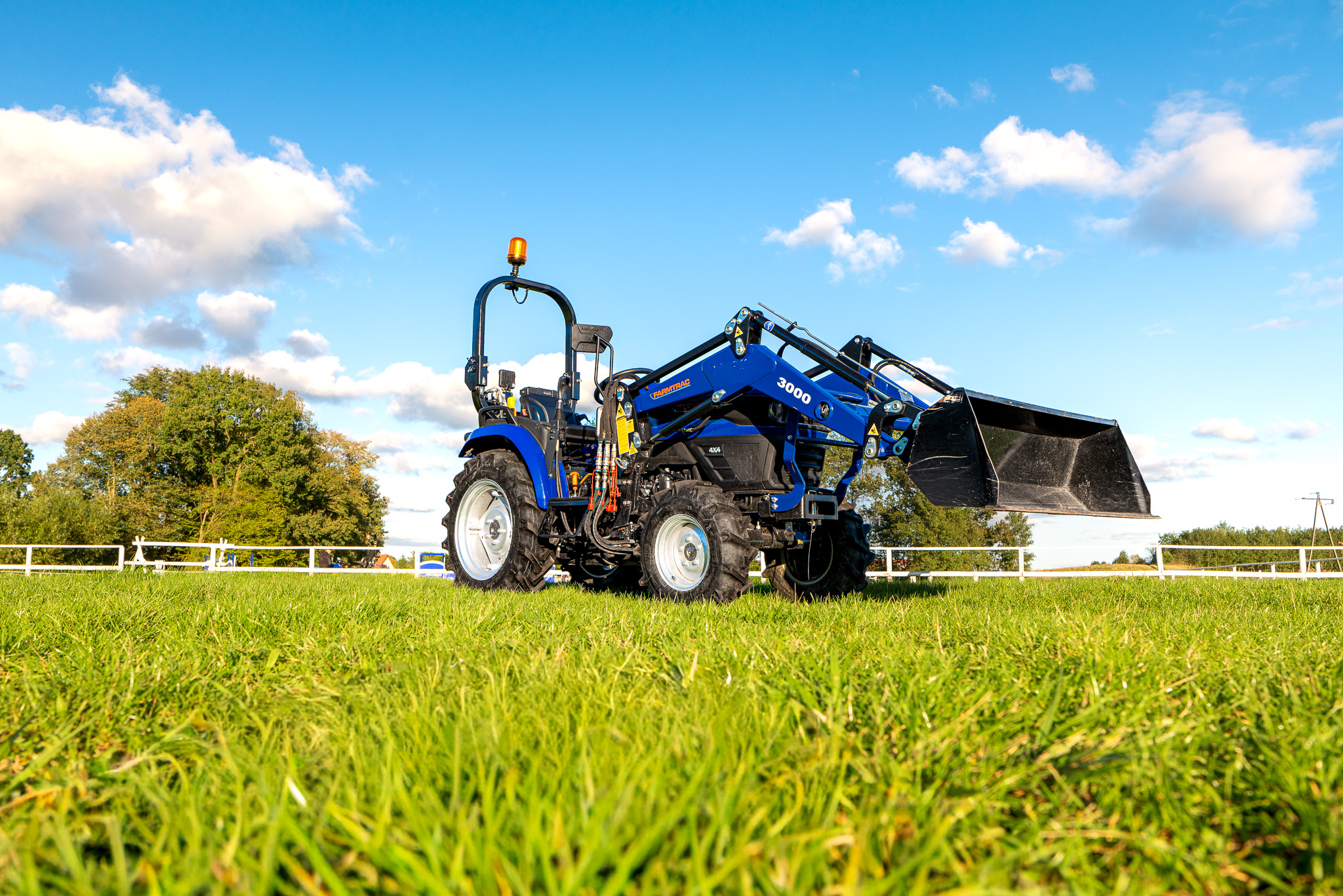
- Farmtrac 26H 4WD
- Farmtrac 26PRO 4WD
In practice:
- for light work, fuel consumption is often between 2-4 l/h
- when working with a loader or heavier loads: 3-5 l/h
Such tractors are most commonly used:
- on farms of up to approx. 10-15 ha
- for everyday, lighter tasks
- in horticultural or municipal companies
How much does an hour of tractor operation cost?
Here, the figures become very concrete.
With diesel at around 7-8 zł/l:
- 3 l/h → approx. 21-24 PLN per hour
- 5 l/h → approx. 35-40 PLN per hour
👉 So in reality: a small tractor costs around 20-40 PLN per hour of operation
And that is the figure that really matters when planning your expenses.
Small vs larger tractor – a difference you can see straight away
For comparison:
|
Tractor type |
Fuel consumption |
Operating cost |
|
small (20-30 HP) |
2-5 l/h |
15-40 PLN/h |
| medium (60-90 HP) | 6-12 l/h |
45-95 PLN/h |
With occasional use, the difference isn’t that noticeable. But with daily work, it really starts to make a difference.
Is a small tractor worth it when fuel is expensive?
In many cases, YES.
Especially if:
- you work on a smaller area
- you do a lot of light work
- you need an ‘all-purpose’ machine for everyday use
It will be less cost-effective if:
- heavy field work is the main task
- you need high performance over a large area
So, as usual – it all depends on what you use it for.
How can you reduce fuel consumption in practice?
A few simple things that really make a difference:
- choose a tractor suited to the job (too big = unnecessary fuel consumption)
- do not overload the machine
- work at a steady engine speed
- ensure regular servicing
- choose the right attachments
A modern tractor will help reduce fuel consumption, but how you operate it still makes a huge difference.
Summary
In 2026, a small agricultural tractor typically consumes 2–5 litres of fuel per hour, which translates to a cost of around PLN 15–40 per hour of operation.
At current fuel prices, this is often a sensible and economical solution – particularly where everyday, versatile work is required.
Fuel consumption in 2026